The Architecture of Performance / The Performance of Architecture


TRANFORMATIVE CULTURAL SPACES IN SHENZHEN
4th-Year Architectural Design Studio at the International
Program in Design and Architecture (INDA), Chulalongkorn University, Bangkok, Thailand

Studio Professor - Cheryl Wing-Zi Wong


Showing posts with label Patlapa Davivongsa. Show all posts

Tuesday, May 13, 2014

SSS: SELF-SUSTAINING SWIM TOWER: A Water Park + Treatment Station by Patlapa Davivongsa

The SSS: Self-Sustaining Swim tower is a water park/water treatment station that maximizes the use of groundwater from the central village well by treating and distributing it to the people in Bai Shi Zhou urban village. The treated water is also used in the water park tower, with structural tube columns that act as water storage and water distribution. 


Thursday, March 20, 2014

Well Project Manifesto by Patlapa Davivongsa

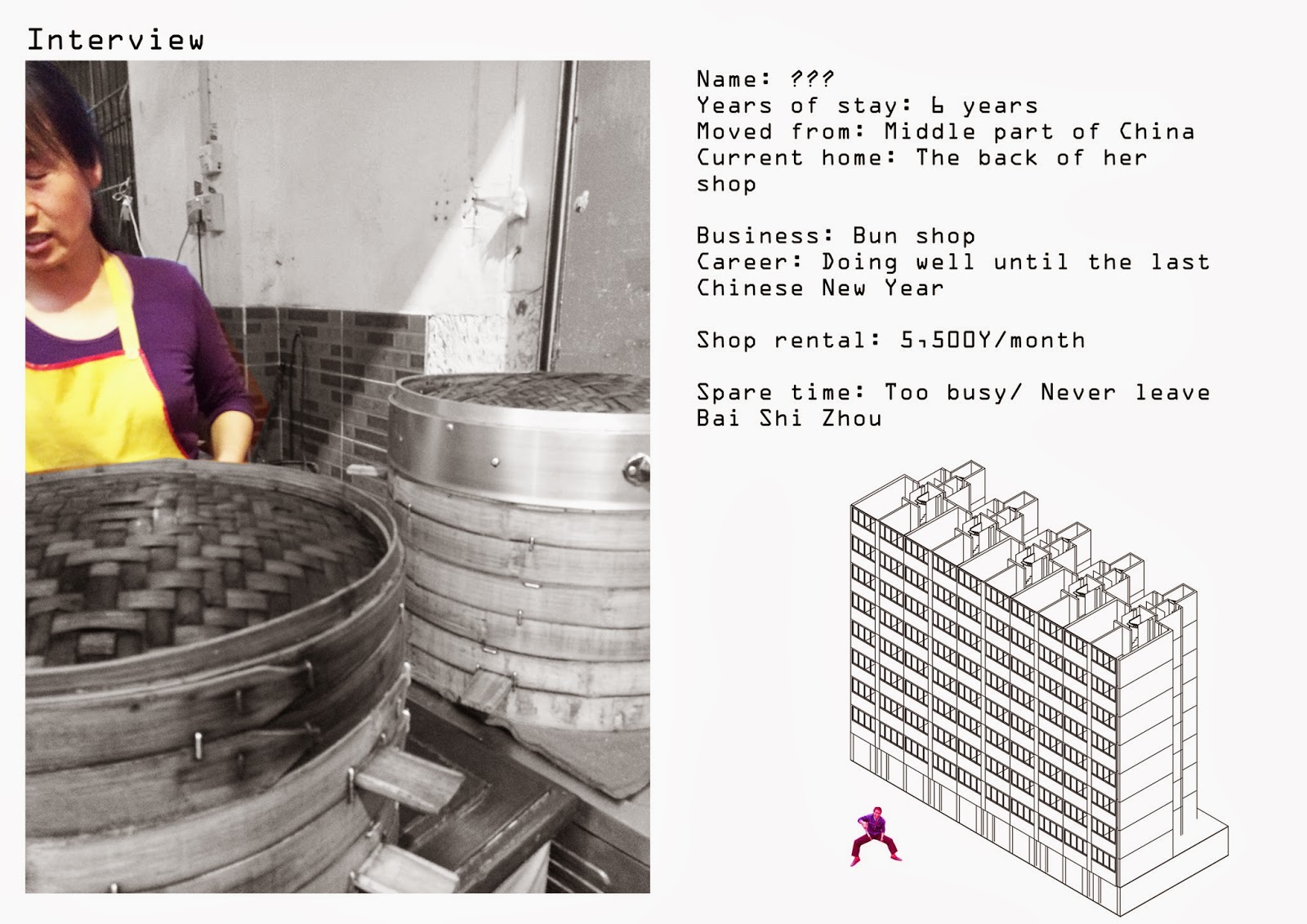
Time is very important to the people in Bai Shi Zhou since they are very busy trying to make a living. Not to mention going out of the area, they don't even have time to relax within the area because Bai Shi Zhou market is always active from morning to night. For a place like this, public space for leisure activities is not demanded. However, a type of social space which integrates everyday necessary activities with public interactive space should be provided in order to create a strong community.


Tuesday, February 25, 2014

Redefining Performance By Patlapa Davivongsa

With my personal interest of interactive performances, I wanted to experiment with peoples' perception of hearing. I used a software called Garage Band to create a sound clip of a scenario for the audience to listen to. By adjusting the volume of each track, I created the sense of space for audiences to imagine, and each of the audience's experience of the space are different according to their own imaginations.


To listen to the sound clip, please click here


Sunday, February 9, 2014

Shenzhen Site Analysis: Bai Shi Zhou, By Atitaya Taratai and Patlapa Davivongsa


Bai Shi Zhou is where the largest urban village in Shenzhen is located. It is divided into 3 zones: the developed zone,  the urban village zone, and the Window of the World zone.


Overall changes in Baishizhou, Shenzhen


Timeline of population in the urban village from the past until now, which affects the building typologies and the growth of the urban village 

The development in transportation also affect the growth of the urban village.
The "kissing buildings" or "handshake buildings" in sections and the transition of the building scale in this area
Because of this, very clear boundaries divided Bai Shi Zhou into 3 different zones.
Here are some possible solutions to solve the problem of overpopulation and poor living conditions in Bai Shi Zhou.

The ideas of redevelopment and the constraints 


click for full resolution


Friday, January 31, 2014

Performance Space Precedents, by Patlapa Davivongsa

For performance spaces, I am personally more interested in the smaller ones because I believe they provide more interaction to the audiences. Different performance spaces serve for different type of performances: the seatings and the stages are designed accordingly. The case studies that I chose to analyze are as follow: 


Jay Prizker Pavilion 
deals with sound performances 
with less focus on the visual performances.


Nature Theatre Auditorium 
reverses the idea of open air theatre 
by having the audiences being indoor.


Pole Dance
 is an interactive exhibition 
that allows the audiences to become performers.


Black Box theatre 
is a type of theater that is only a black squared box 
which can be set up into variety of performances.


Walt Disney Modular Theater
 is an example of a Black Box theater.
 Its unique element is the movable floors, walls, and ceilings.


Zhongguancun Christian Church 
is a different from other typical churches 
because of its unusual shape. 
I am interested in how beliefs 
create  different experiences for people in spaces.