The Architecture of Performance / The Performance of Architecture


TRANFORMATIVE CULTURAL SPACES IN SHENZHEN
4th-Year Architectural Design Studio at the International
Program in Design and Architecture (INDA), Chulalongkorn University, Bangkok, Thailand

Studio Professor - Cheryl Wing-Zi Wong


Showing posts with label Phase 1. Show all posts

Friday, January 31, 2014

Performance Space Precedents, Ekkrit Suwanwong

The set of these 6 precedents of performance architecture are  comparatively analyzed  by the evolution of ‘theatre’ space in which starts from the classical amphitheater to the contemporary  projection space. The representations of each space design conform to the changing context of time and culture in different eras.  Due to this change, the language of performance architecture has interactively impacted to the roles between performers and audiences, in which create total new experiences in perceiving performances. 

The selected precedents are Teatro Olimpico, Bolshoi Theatre, Bayreuth Festival House, Prometeo Musical Space, Philips Pavilion and Prometeo Hall at AIAV.


Teatro Olimpico

link to high resolution file

Bolshoi Theatre

link to high resolution file

Bayreuth Festival House

link to high resolution file

Prometeo Musical Space

link to high resolution file

Philips Pavilion'58

link to high resolution file

Prometeo Hall at Akiyoshidai International Art Village

link to high resolution file


Performance Space Precedents, Bunyawat Thannipat

                                                             click here for high resolution

Performance Space Precedents, by Suthiwat Yanawiboot

The study of following precedents shows the relationship between performing space and 
audience position. Also the revolutions and relationship to each function.

(From left to right)
Shenzhen Bay Sports Center
Royal Opera House
Royal Albert Hall
Berlin Philharmonie
La Scala
New World Center


Shenzhen Bay Sports Center
Shenzhen, China
2011


Royal Opera House
Covent Garden, London
1734
                                                      Click here for high resolution                                                      


Royal Albert Hall
South Kensington, London
1871
 Click here for high resolution


Berlin Philharmonie
Berlin, Germany
1963
 Click here for high resolution


La Scala
Milan, Italy
1778
Click here for high resolution


New World Center
Miami, Florida
2011

Performance Space Precedents, by Atitaya Taratai

The 6 precedents that I analyzed under different scales from bigger to smaller : 
urban scale context,programs, theatre or auditorium scale


CASA DA MUSICA
urban : how urban pattern related to the form of the building
programs : primary program is at the center of the building and the remaining 
space  as a secondary programs
auditorium : the visual connection  


the concept of using glass volume to show the idea of gathering 
programs together that can explain from the exterior the hierarchy
and relation between space and function  


the building base on the concept of stages not only the auditorium
inside but also the outdoor stage at the huge plaza at the river front 

this precedent show how building interact with the bigness of the city
and context 


transformation of the stage without using mechanical system
but using modular system design 


 Perfermances which held in the arena are the performance that give audience
more than one perspective eg. gladiator sport competition etc.
different from theatre perspective.


Performance Space Precedents, by Samascha Samcharoen

Various performance spaces have undergone several metamorphosis from the so-called 'traditional' design into an experimental spaces.  This blog will guide you through all the precedents in a chronological order so that you will be able to observe the changes and some preserved similarities within each  performance spaces.   Which aspects of changes are significant; which are subtle, in the course of 50 years period..?


Click here to view full resolution

 Sydney Opera House 
One of the most original performance spaces that situated in the heart of Sydney.  This architectural masterpiece serves not only as an opera house but also a symbolic architecture representing Australia. Situated adjacent to the body of water, Sydney Opera House can be seen from afar; making it a national landmark.  Due to its construction date in 1959, the opera hall design is consider traditional and very generic; making it one of the predecessors of today's contemporary opera house.
 
Click here to view full resolution 

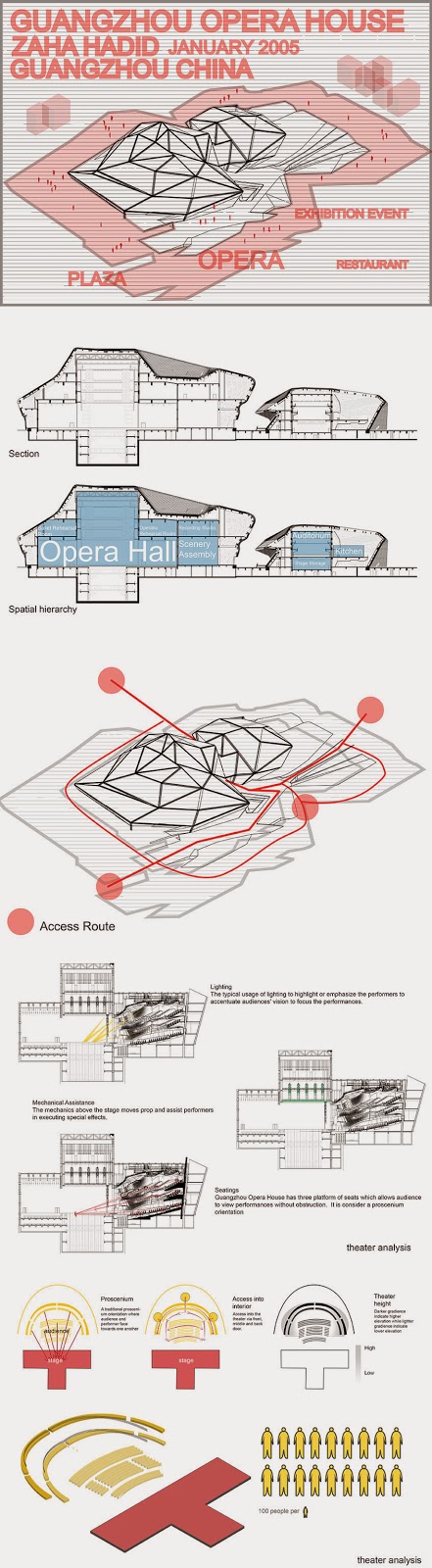
 Guangzhou Opera House
Although the exterior resembles that of a futuristic architecture, Guangzhou Opera House still execute the typical design of the performance spaces.  The opera hall resembles that of Sydney Opera House which are rather typical and generic whether in terms of seatings arrangement, light , and volume.
    
 Click here to view full resolution 

  Oslo Opera House
The special features of this opera house are the aperture that allows natural light to penetrate into interior space. 
Another unique features include the elevator that allows the stage to move up or down; making it more flexible for various types of performances.  Oslo Opera Hall pulled itself from generic design and began to be revolutionary in its design in terms of new features which include elevator, light aperture, and larger spatial volume.
  
 Click here to view full resolution

 Open-air Pavillion
Open-air Pavillion, as its name stated, is situated in an open public space in Austria.  The open-space performance area is different from any other precedents in terms of acoustics, light, and seatings capacity.  Seatings has to be lesser in numbers due to the needs of acoustics control.  Natural light is crucial to the space which is the main source of lighting.  Acoustics tend to be disperse in an open area and is not contained like other close-space opera house.  
 
 Click here to view full resolution

 Shenzhen Concert Hall
Although Shenzhen Concert Hall was built back in 1998, the concert hall design is considered to be one of the more revolution ones.  The acoustics qualities are considered to be top-notch by various acousticians from all around the world.  
 
 Click here to view full resolution

 Taipei Performing Arts Center
The most revolutionary performance space of all the previous precedents.  The building comprises of three independent performance spaces which include proscenium theater, Grand theater and multiform theater.  The three spaces could be combined into one gigantic performance spaces that allows flow of audiences from 360 degrees point of views, making it one of the most innovative and flexible performance spaces ever designed.
 

Performance Space Precedents, by Smith Wararatchai

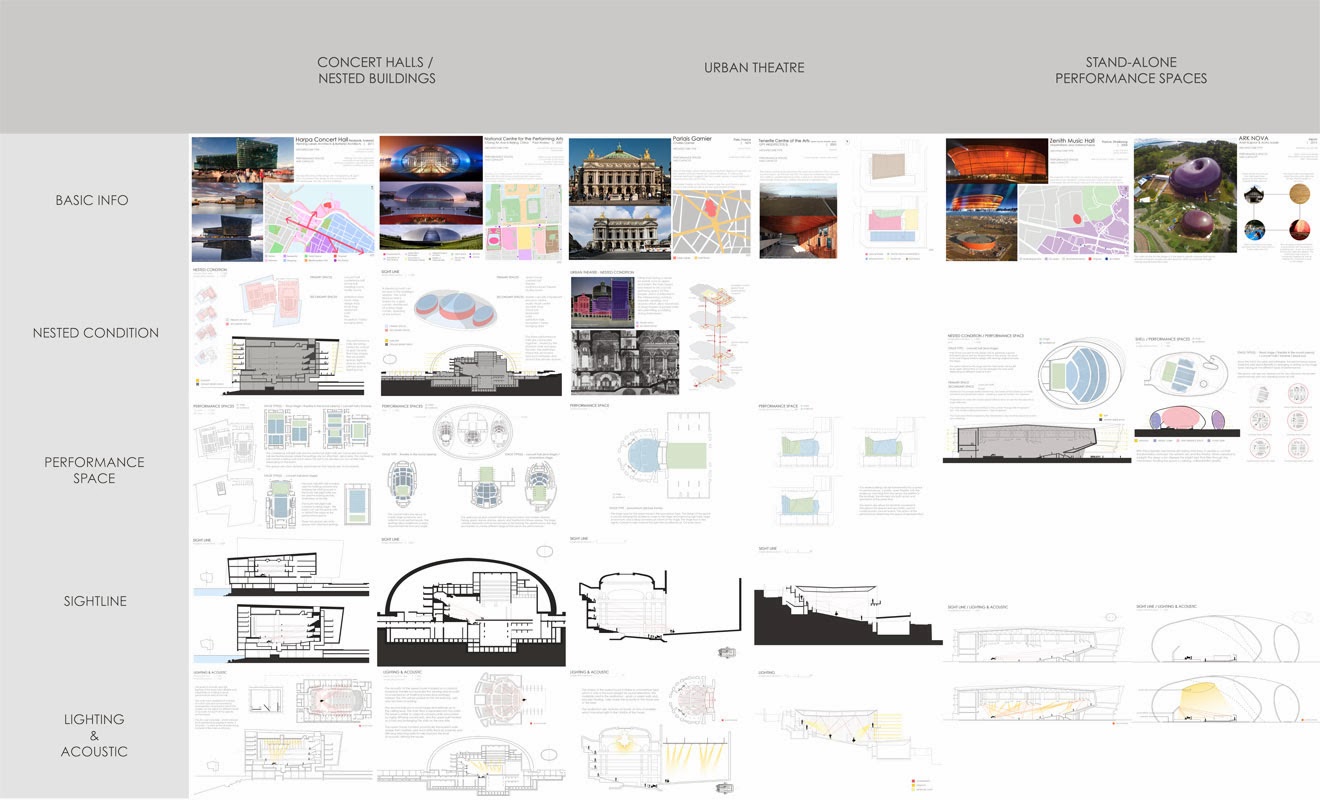
Each of the precedents were analysed and compared under four topics : nested condition, performance space(s), sightline(s), and lighting and acoustic. The projects were also classified into three different categories : concert halls (nested buildings) or buildings that contains more than one performance space and other facilities, urban theatre - projects that generate community within itself, and stand alone performance spaces - projects such as arena or stadium that mainly functions as performance space only. From this phase, I have drawn interesting ideas such as the idea of social dynamic within the spaces shaped by the facades as well as creating a community within the building itself.


CONCERT HALLS (NESTED BUILDINGS)

Harpa Concert Hall
- This precedent mainly focus on how the design can reflect the city and the surrounding context. It also deals alot with the idea of light spaces (glass facade) and rigid spaces (concert halls).


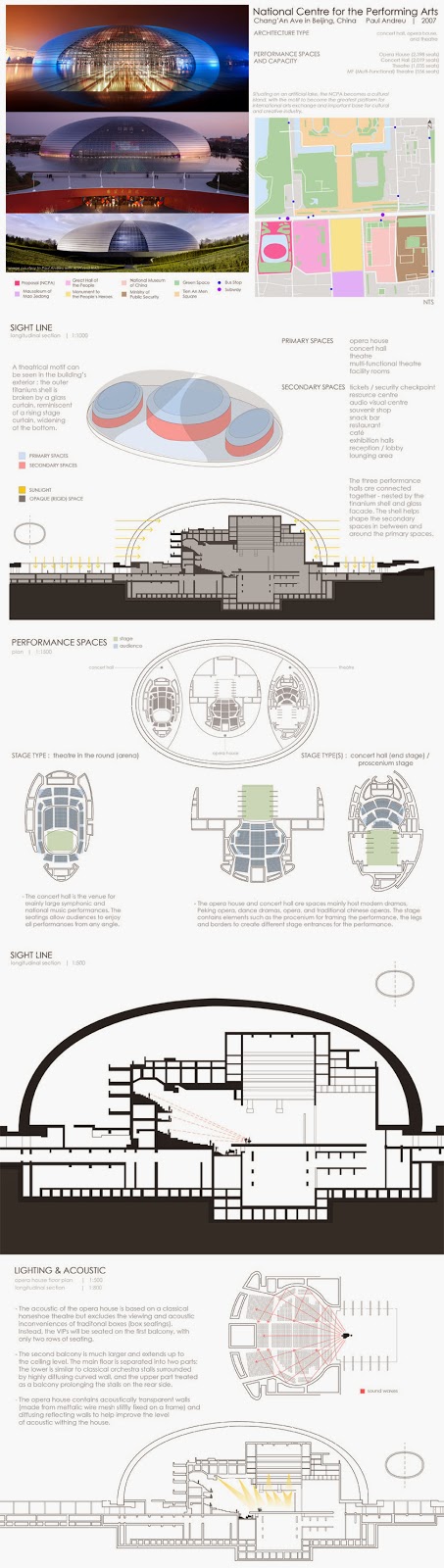
Beijing National Centre of Performing Arts
- This precedent also deals alot with the idea of having the glass facade shaping the secondary spaces in between the primary spaces.


URBAN THEATRE

Palias Garnier
- This Opera house is not only the icon for the city but as well as the public center built for both performing arts and socialization.


Tenerife Centre of Dramatic Arts
- This building focus mainly on the open-air auditorium located in the middle of the building. The space functions as a route where students walk pass as well as become the scenic box framing the city.


                                                                  link to full resolution  


                                          STAND-ALONE PERFORMANCE SPACE

Zenith Hall
- The Zenith Hall is designed from the concept of trying to give the best view to all audiences, resulting in an oval shape. The building also serves as a light architecture by using a textile membrane, when lit up, it projects the interior to the exterior.


Ark Nova
- Ark Nova is a mobile theatre aim to travel around areas that were destroyed by the Tsunami disaster in Japan. The idea of the project aims to help comfort the people as well as bring the community together.


Performance Space Precedents, by Patlapa Davivongsa

For performance spaces, I am personally more interested in the smaller ones because I believe they provide more interaction to the audiences. Different performance spaces serve for different type of performances: the seatings and the stages are designed accordingly. The case studies that I chose to analyze are as follow: 


Jay Prizker Pavilion 
deals with sound performances 
with less focus on the visual performances.


Nature Theatre Auditorium 
reverses the idea of open air theatre 
by having the audiences being indoor.


Pole Dance
 is an interactive exhibition 
that allows the audiences to become performers.


Black Box theatre 
is a type of theater that is only a black squared box 
which can be set up into variety of performances.


Walt Disney Modular Theater
 is an example of a Black Box theater.
 Its unique element is the movable floors, walls, and ceilings.


Zhongguancun Christian Church 
is a different from other typical churches 
because of its unusual shape. 
I am interested in how beliefs 
create  different experiences for people in spaces.