The Architecture of Performance / The Performance of Architecture


TRANFORMATIVE CULTURAL SPACES IN SHENZHEN
4th-Year Architectural Design Studio at the International
Program in Design and Architecture (INDA), Chulalongkorn University, Bangkok, Thailand

Studio Professor - Cheryl Wing-Zi Wong


Showing posts with label Smith Wararatchai. Show all posts

Sunday, May 11, 2014

MOSAIC : Caiwuwei Performing Arts and Cultural Center by Smith Wararatchai

MOSAIC represents the patchwork of varieties of life, culture, and style of people throughout the history of Shenzhen. The design of the building was generated through the existing historical village buildings' footprints to preserve the sense of history of the Luohu District.

The iconic vertical concert hall is a breakdown of the traditional orchestral arrangement, challenging the common sightline in a performance as well as creating a vertical acoustic experience for the audience. MOSAIC does not only aim to represent modern day Shenzhen, but also poses a future for the development of music composition for such vertical performance space.


--


PRESENTATION PANELS:


                                      Click for Full Resolution : 01 / 02 / 03 / 04 / 05 / 06


MODEL DOCUMENTATIONS:


                           Click for Full Resolution : 01 / 02 / 03 / 04 / 05 / 06


Tuesday, March 18, 2014

Architectural Marker - Project Manifesto by Smith Wararatchai


For a developing city, time is a valuable factor in the process of development. Therefore, it is important for an ‘architectural marker’ to exist as a milestone to commemorate the rapid growth of the city. Owing to the fact that throughout the history, architecture is the biggest, most significant, man-made object that plays an important role in fabricating the physical appearance of the city along with its geographical features. To make a successful ‘architectural marker’, it is relevant that a harmonious relationship exists between the sense of community, economic growth of the city, and the cultural and artistic values behind it.

In many developing cities, symbolic architectures were constructed in relation to the municipal buildings as to display the prosperity and the development of the city. Shenzhen, one of the world's fastest developing city, contains many examples of symbolic architecture such as the Grand Theatre which was built to witness the reform of the country and the Shenzhen Concert Hall which was built as a milestone during the relocation of the main municipal building of Shenzhen. However, these symbolic architectures are not considered as architectural markers since they lacked the sense of community within the architecture itself.


Click for High Resolution (PDF) (JPG)

Tuesday, February 25, 2014

'Through the Portal' : Redefining Performance Piece by Smith Wararatchai

"Performance" to me is redefined as the balance between the front stage (upstage) and the backstage dynamics. From this idea, I have choreographed a performance showing one aspect of the concept by using the idea of exposure - allowing the audiences to be exposed to the normal condition of the site. The performance also challenges the idea of normal sightline by having a directly vertical sightline for the piece.


Monday, February 10, 2014

Shenzhen Site Analysis: Cei Wu Wei - Urban Village, By Ekkrit Suwanwong and Smith Wararatchai


Cei Wu Wei - is a portion of urban village in the Luoho district of Shenzhen urban area. It is an area with historical background as an urban village, which is the residential community of migrants existing parallel to the area being developed as the main 'financial' district of the city. The timeline presents the swiftly changing transformation of the area. 

1. Timeline
2. Elevation photomontage to scale
link to high resolution file 1. 2.
3. 1938 - Agriculture land and Fishing Village along the Shenzhen River
link to high resolution file 3.
4. 1950 - the development has moved with the new governmental office settlement from the west district 'Bao an', resulting the extension of avenue to the Cei Wu Wei area
link to high resolution file 4.
5. West to East - a strategic relocation of neighboring Hongkong Border
link to high resolution file 5.
6. and 7.  During the settlement of financial district, local farmland owner turns their lands into residential units, resulting in urban villages formation and creating 
'Handshake Building', (overlapping units adjacent)
link to high resolution file 6.and 7.
8. 1980 - Migration of 'Hukou' or the local official population causes the increase of population size
link to high resolution file 8.
9. Hokous mainly come from the central part of China
link to high resolution file 8.
9. Age of working population 
link to high resolution file 8.
10. since 1980s - Cei wu wei land is replaced with development of high business and residential buildings 
link to high resolution file 9.
11. and 12. Specific architecture is built to represent as an iconic piece which has economic, political and social impacts to the modern society of Shenzhen
link to high resolution file 11 and 12.
13. and 14.  at Present day- zones of space are transformed in which residential/local commercial zone are invading by the 'new' or official financial district, and resulting the contrast of urban planning and the social effects
link to high resolution file 11 and 12.


From the study, we have come up with the further questions to the Cei Wu Wei area. With possible changes in the future, the conflict between the 'residential' and 'financial district'  zones would be the cause of change in both social trends and urban fabric.

Friday, January 31, 2014

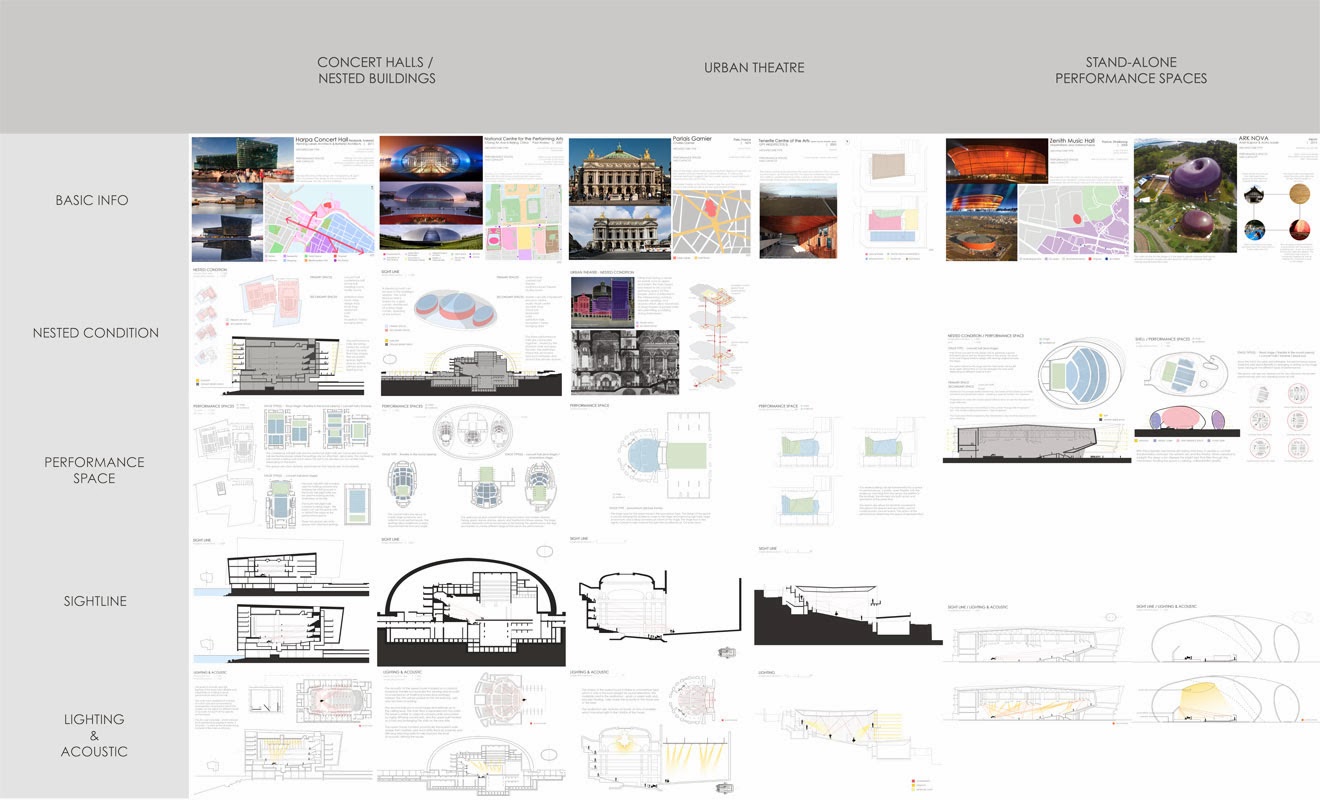
Performance Space Precedents, by Smith Wararatchai

Each of the precedents were analysed and compared under four topics : nested condition, performance space(s), sightline(s), and lighting and acoustic. The projects were also classified into three different categories : concert halls (nested buildings) or buildings that contains more than one performance space and other facilities, urban theatre - projects that generate community within itself, and stand alone performance spaces - projects such as arena or stadium that mainly functions as performance space only. From this phase, I have drawn interesting ideas such as the idea of social dynamic within the spaces shaped by the facades as well as creating a community within the building itself.


CONCERT HALLS (NESTED BUILDINGS)

Harpa Concert Hall
- This precedent mainly focus on how the design can reflect the city and the surrounding context. It also deals alot with the idea of light spaces (glass facade) and rigid spaces (concert halls).


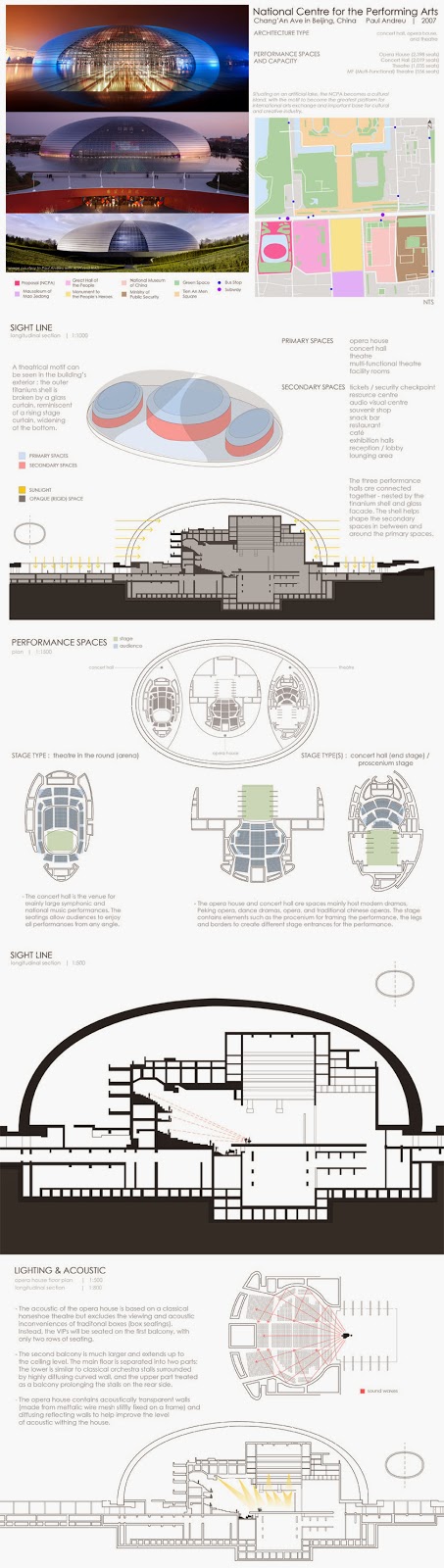
Beijing National Centre of Performing Arts
- This precedent also deals alot with the idea of having the glass facade shaping the secondary spaces in between the primary spaces.


URBAN THEATRE

Palias Garnier
- This Opera house is not only the icon for the city but as well as the public center built for both performing arts and socialization.


Tenerife Centre of Dramatic Arts
- This building focus mainly on the open-air auditorium located in the middle of the building. The space functions as a route where students walk pass as well as become the scenic box framing the city.


                                                                  link to full resolution  


                                          STAND-ALONE PERFORMANCE SPACE

Zenith Hall
- The Zenith Hall is designed from the concept of trying to give the best view to all audiences, resulting in an oval shape. The building also serves as a light architecture by using a textile membrane, when lit up, it projects the interior to the exterior.


Ark Nova
- Ark Nova is a mobile theatre aim to travel around areas that were destroyed by the Tsunami disaster in Japan. The idea of the project aims to help comfort the people as well as bring the community together.