The Architecture of Performance / The Performance of Architecture


TRANFORMATIVE CULTURAL SPACES IN SHENZHEN
4th-Year Architectural Design Studio at the International
Program in Design and Architecture (INDA), Chulalongkorn University, Bangkok, Thailand

Studio Professor - Cheryl Wing-Zi Wong


Showing posts with label Samascha Samcharoen. Show all posts

Sunday, May 11, 2014

SHENZHEN PERFORMING ARTS PLATORMS by Samascha Samcharoen

On an urban scale, Shenzhen is a commuter city where people tend to rely on vehicles as a means of transportation.  Unlike most other places in Shenzhen, the district of OCT was designed to accommodate the walkability of pedestrians throughout the area.  With this privilege, along with the invisible boundaries that separate the two sub-districts of OCT, my design proposal embarks upon creating layers and networks of existing pedestrians footprints that physically and programmatically bring interactions between the two disconnected contexts.  Furthermore, the design itself is a transformative platform that merges the segregated urban layers into an interdependent performance architecture that dually serves as a concert hall during events and also as recreational space.  The design is also considered to be an urban stage where, according to the redefinition of performance, boundaries between performer and audience is blurred, and everyone in the space is considered to have their own role as either audience or performer.  The space is activated by humans as an input to the architecture.


Friday, March 21, 2014

'Talk to me, OCT...." Project Manifesto by Samascha Samcharoen


OCT Loft is one of the instances depicting an urban setting that uses revitalization as a tool to develop a space; dissimilar to most other parts of Shenzhen, including the adjacent neighborhood where tabula rasa has occurred and developments are based solely on new construction.  OCT Loft has reached the point of development that, nowadays can be juxtaposed to its neighboring context in the OCT district.

The physical boundaries of the two districts are bounded by a two-lane street that does not initially seem significant.  The invisible boundary between the two districts is what I am interested in exploring and where I am trying to intervene.  Although the two districts are situated close to each other, there seems to be an invisible wall that separates the dialogue, making the two sides a disconnected context. 

The intervention will become a performance architecture that connects and creates dialogue between the two highly contrasted districts amidst its adjacency.  The architecture will create interaction (visually, physically) between the two greatly juxtaposed communities by means of situating a transformative performances space in between the invisible boundary. 


Tuesday, February 25, 2014

"Performance = ? : Redefining Performance by Samascha Samcharoen"


Witness an attempt to redefine what a performance really is.

Redefinition of performance: 
 Performers don't only perform, but become an audience at the same time who spectates the feedback from the actual audiences.

While audiences are spectating the performance; at the same time they are also performers who give feedback to the performer. 

The relationship between performers and audiences are therefore interrelated.  Everyone is actually a performer/audience at the same time and is not considered to be only one or the other.  The boundaries between the two are blurred. 
 

Performers and audiences are consider to be the two crucial elements of performance but they are always considered to be two separated elements.

 click here for higher resolution

Same goes to performance space; seatings and stage coexist.
  click here for higher resolution

Everyone is actually a performer and audience at the same time.
  click here for higher resolution

Movements Algorithm 
  click here for higher resolution

 Experiment diagram
  click here for higher resolution

Experiment diagram
  click here for higher resolution

Experiment Results
  click here for higher resolution

Experiment Results 
  click here for higher resolution

Experiment Results 


Friday, January 31, 2014

Performance Space Precedents, by Samascha Samcharoen

Various performance spaces have undergone several metamorphosis from the so-called 'traditional' design into an experimental spaces.  This blog will guide you through all the precedents in a chronological order so that you will be able to observe the changes and some preserved similarities within each  performance spaces.   Which aspects of changes are significant; which are subtle, in the course of 50 years period..?


Click here to view full resolution

 Sydney Opera House 
One of the most original performance spaces that situated in the heart of Sydney.  This architectural masterpiece serves not only as an opera house but also a symbolic architecture representing Australia. Situated adjacent to the body of water, Sydney Opera House can be seen from afar; making it a national landmark.  Due to its construction date in 1959, the opera hall design is consider traditional and very generic; making it one of the predecessors of today's contemporary opera house.
 
Click here to view full resolution 

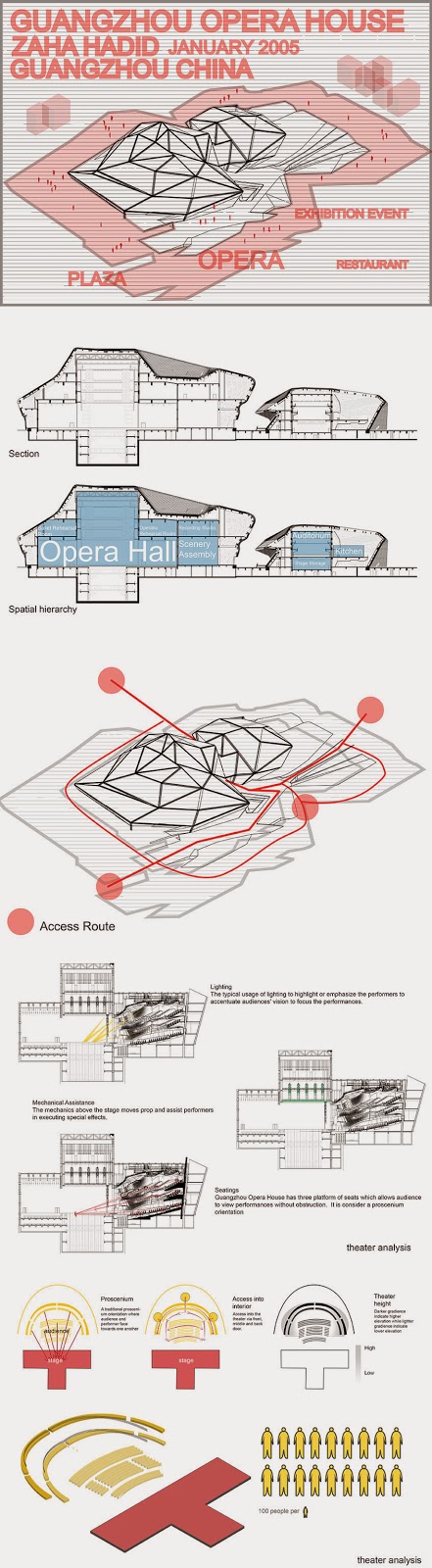
 Guangzhou Opera House
Although the exterior resembles that of a futuristic architecture, Guangzhou Opera House still execute the typical design of the performance spaces.  The opera hall resembles that of Sydney Opera House which are rather typical and generic whether in terms of seatings arrangement, light , and volume.
    
 Click here to view full resolution 

  Oslo Opera House
The special features of this opera house are the aperture that allows natural light to penetrate into interior space. 
Another unique features include the elevator that allows the stage to move up or down; making it more flexible for various types of performances.  Oslo Opera Hall pulled itself from generic design and began to be revolutionary in its design in terms of new features which include elevator, light aperture, and larger spatial volume.
  
 Click here to view full resolution

 Open-air Pavillion
Open-air Pavillion, as its name stated, is situated in an open public space in Austria.  The open-space performance area is different from any other precedents in terms of acoustics, light, and seatings capacity.  Seatings has to be lesser in numbers due to the needs of acoustics control.  Natural light is crucial to the space which is the main source of lighting.  Acoustics tend to be disperse in an open area and is not contained like other close-space opera house.  
 
 Click here to view full resolution

 Shenzhen Concert Hall
Although Shenzhen Concert Hall was built back in 1998, the concert hall design is considered to be one of the more revolution ones.  The acoustics qualities are considered to be top-notch by various acousticians from all around the world.  
 
 Click here to view full resolution

 Taipei Performing Arts Center
The most revolutionary performance space of all the previous precedents.  The building comprises of three independent performance spaces which include proscenium theater, Grand theater and multiform theater.  The three spaces could be combined into one gigantic performance spaces that allows flow of audiences from 360 degrees point of views, making it one of the most innovative and flexible performance spaces ever designed.